

16Jul 26 Payroll Outsourcing Services: Costs, Benefits, and How to Choose in 2026
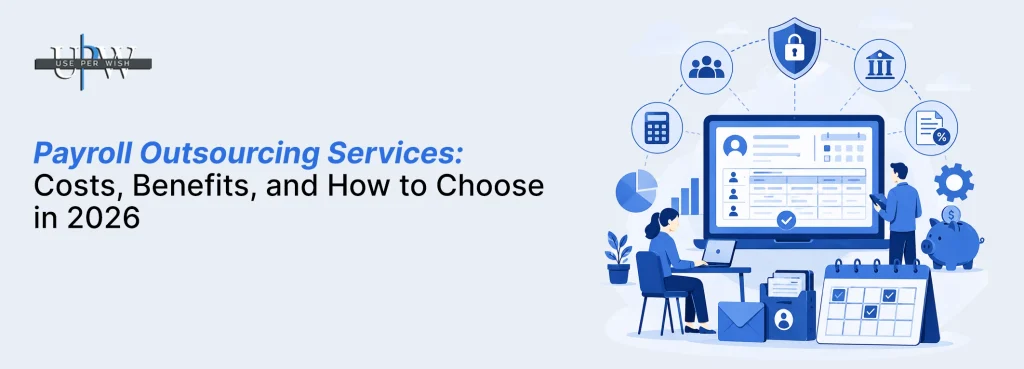
Payroll outsourcing services let you hand off payroll processing, tax filing, direct deposits, and compliance to a third-party provider so your team doesn’t have to manage them in-house. For most businesses, this means fewer compliance headaches, fewer costly errors, and hours of administrative time freed up for higher-value work.
This guide explains what payroll outsourcing services include, what they cost in 2026, the real pros and cons, how they compare to in-house payroll and PEOs, and exactly how to choose the right provider.
Key takeaways
- What it is: Hiring an external provider to run some or all of your payroll — calculations, tax withholding and filing, payments, and reporting.
- What it costs: Typically $200–$250 per employee per year, or roughly a $20–$100/month base fee plus $4–$12 per employee per pay run. Cost scales with headcount, pay frequency, number of states, and complexity.
- Biggest benefits: Time savings, higher accuracy, built-in tax compliance, stronger data security, and easy scalability.
- Biggest trade-offs: Some loss of control, dependence on the provider’s timelines, and entrusting sensitive data to a third party.
- Who it fits best: Businesses with roughly 5–50+ employees, multi-state teams, or anyone who has faced payroll tax penalties.
- The employer stays responsible for supplying accurate data and validating each pay run — outsourcing reduces risk but doesn’t remove all liability.
What Is Payroll Outsourcing?
Payroll outsourcing is the practice of hiring a third-party company to handle some or all of your payroll functions instead of managing them internally. Rather than a business owner, office manager, or in-house team running each pay cycle, a specialized provider takes over the logistics.
A payroll outsourcing company — also called an outsourced payroll provider — is responsible for calculating wages, withholding and remitting taxes, ensuring legal compliance, and often administering employee benefits and deductions. The goal is simple: pay employees accurately and on time while staying compliant with federal, state, and local rules.
You can outsource fully (the provider handles everything end to end) or partially (you keep some tasks in-house and offload the complex parts, like tax filing). Providers typically offer tiered packages designed to either support or completely replace an in-house payroll operation.
How Does Payroll Outsourcing Work?
Outsourced payroll follows a repeatable cycle each pay period. Once you’ve selected a provider and completed setup, the process usually looks like this:
- You share employee data — hours worked, salary changes, new hires, and terminations.
- The provider calculates pay — gross wages, deductions, taxes, and net pay for each person.
- Taxes are withheld and filed — the provider remits and files payroll taxes with the IRS and applicable state agencies.
- Employees get paid — via direct deposit or check on the scheduled payday.
- Reports are delivered — the provider generates payroll reports and maintains records for compliance.
Your main ongoing responsibility is supplying accurate inputs and validating payroll at the end of each cycle.
What Services Are Included in Payroll Outsourcing?
Core payroll outsourcing services usually cover:
- Payroll processing — calculating wages, deductions, and employer tax obligations
- Tax administration — withholding, remitting, and filing payroll taxes; monitoring regulatory changes
- Compliance monitoring — keeping pace with federal, state, and local rules, including ACA reporting
- Reporting — quarterly and annual filings
- Year-end processing — generating W-2 and 1099 forms
- Direct deposit and payment — paying employees and contractors
- Employee self-service — portals for pay stubs and tax documents
Common add-on services (often priced separately) include time and attendance tracking, benefits administration, wage garnishment processing, new hire reporting, and off-cycle payroll runs. Always confirm what’s in the base fee versus what costs extra.
How Much Do Payroll Outsourcing Services Cost in 2026?
Most businesses pay between $200 and $250 per employee per year for payroll outsourcing — or roughly a $20–$100 monthly base fee plus $4–$12 per employee per pay run. Your actual price depends on how many people you pay, how often, in how many states, and how complex your payroll is.
Common pricing models
| Pricing model | How it works | Best for |
|---|---|---|
| Base fee + per employee | A monthly base charge plus a fixed rate per employee | Most small and mid-sized businesses |
| Per pay run | A fee each time payroll is processed | Companies that run payroll infrequently |
| Tiered packages | Bundled tiers that add tax filing, compliance, and HR as you move up | Growing businesses wanting integrated services |
Typical cost ranges by business size
| Business size | Typical monthly cost |
|---|---|
| Under 10 employees | ~$70–$220 |
| 10–25 employees | ~$100–$300 |
| 25–50 employees | ~$300–$700 |
| 50+ employees | Custom / negotiated (often volume-discounted per employee) |
What drives the price up
- Employee count — the primary cost driver; most providers charge per employee.
- Pay frequency — weekly runs cost more than bi-weekly or monthly.
- Number of states — multi-state payroll adds tax filings and compliance work.
- Complexity — contractors, multiple pay rates, tipped or shift-based wages, and benefits all add cost.
- Add-ons — time tracking, benefits administration, garnishments, off-cycle runs, and setup fees can turn a “$60/month” plan into far more.
Tip: Always request an all-in quote that lists every add-on before signing. Getting quotes from three providers commonly saves businesses 15–30% versus taking the first offer.
Benefits of Outsourcing Payroll
1. Save time. Payroll is repetitive and detail-heavy. Outsourcing frees internal resources — often saving several hours per pay period — to focus on growth, customers, and strategy.
2. Reduce errors. The IRS has estimated that roughly one in three employers is hit with a payroll-related penalty. Specialized providers process payroll with greater accuracy and help you avoid those fines.
3. Stay compliant. Providers track changing federal, state, and local tax laws and handle filings, ACA reporting, and new-hire reporting — reducing your regulatory exposure.
4. Strengthen data security. Reputable providers invest in encryption, redundant backups, and multiple secure server locations — often more robust than a small in-house team could build alone.
5. Scale easily. As you add employees, locations, or states, a provider scales with you without you rebuilding your payroll system.
Risks and Disadvantages of Payroll Outsourcing
No business decision is one-sided. The main trade-offs to weigh:
- Loss of control. You depend on the provider’s systems and schedule, which can limit flexibility over timing and process.
- Data security exposure. You’re entrusting sensitive employee data — Social Security numbers, bank details, salaries — to a third party. Vet their security practices and breach history.
- Communication delays. Issues must be resolved through support channels rather than by walking over to a colleague, which can slow urgent fixes.
- Retained liability. You generally remain responsible for accurate data and final sign-off; outsourcing reduces but doesn’t eliminate your obligations.
- Paying for unused services. Bundled tiers may include features you don’t need.
Most of these risks are manageable by choosing an established provider and reading the contract carefully — especially the fee schedule, correction turnaround times, and data-incident policy.
In-House vs. Outsourced Payroll
| Factor | In-house payroll | Outsourced payroll |
|---|---|---|
| Time | High — staff hours every pay period | Low — a few hours to review |
| Cost | Software + salary/training | Predictable service fee |
| Compliance risk | Rests entirely on your team | Shared with a specialist |
| Control | Full | Partial (provider-dependent) |
| Accuracy | Varies with staff expertise | Typically higher |
| Scalability | Manual to scale | Built-in |
Rule of thumb: Under 5 employees, DIY software can be enough. Between 5 and 50 employees is the sweet spot for outsourcing — the cost is small and the time and penalty-protection savings are real. Above 50, price both outsourcing and a dedicated in-house hire, especially if you also have broader HR needs.
Payroll Outsourcing vs. PEO vs. EOR
These are often confused, and the difference comes down to who holds employer liability:
- Payroll outsourcing: You remain the legal employer and simply hand off payroll processing.
- PEO (Professional Employer Organization): Acts as a co-employer, taking on shared responsibility for HR, payroll, and compliance — and giving access to better-priced benefits, but with less flexibility.
- EOR (Employer of Record): Becomes the legal employer on your behalf, commonly used to hire internationally without setting up a local entity.
Choose plain payroll outsourcing when you want to keep control and only offload processing. Consider a PEO or EOR when you want broader HR coverage or are hiring across borders.
Signs It’s Time to Outsource Payroll
Consider outsourcing if you:
- Have been penalized for late or incorrect tax filings
- Spend executive time double-checking payroll or scrambling before deadlines
- Are expanding into multiple states or countries
- Lack in-house payroll or compliance expertise
- Are growing fast and adding employee types (contractors, part-time, tipped, remote)
If payroll regularly causes stress or eats into strategic work, that’s usually a structural signal — not a one-off clerical issue.
How to Choose a Payroll Outsourcing Provider
Evaluate candidates against these criteria:
- Data security — encryption, access controls, backup practices, and breach history.
- Compliance expertise — how they train staff on tax law and keep current.
- Service scope — payroll only, or HR, benefits, and time tracking too.
- Integrations — with your accounting and HR systems to avoid duplicate data entry.
- Support quality — responsiveness, a dedicated contact, and correction turnaround times.
- Scalability — ability to grow with your headcount and geography.
- Transparent pricing — a full fee schedule with no surprise add-ons.
- References and reviews — ask for client references and read independent reviews.
Before you sign, ask: What’s included in the base fee? How fast are corrections handled? How do you handle a data incident? What happens at year-end and with multi-state filings?
Payroll Outsourcing for Small Businesses
Small businesses gain the most proportional benefit. Roughly a third of small businesses outsource at least one process, and payroll is among the most commonly outsourced. For a team of 5–25, outsourcing typically costs a modest monthly fee while removing the biggest source of tax-penalty risk and buying back owner time that can go toward revenue-generating work.
Global and International Payroll Outsourcing
If you employ people across countries, payroll grows more complex fast — each jurisdiction adds its own tax, benefit, and compliance obligations. Global payroll providers (often paired with EOR services) consolidate multi-country payroll into one system, handle currency conversion and local compliance, and let you pay international teams without standing up a legal entity in every country.
Frequently Asked Questions
What is payroll outsourcing?
Payroll outsourcing is hiring a third-party provider to handle payroll processing, tax filing, direct deposits, and compliance instead of managing them in-house.
How much do payroll outsourcing services cost?
Most businesses pay a monthly base fee plus a per-employee charge — commonly around $200–$250 per employee per year. Costs rise with headcount, pay frequency, number of states, and complexity.
How does payroll outsourcing work?
You share employee and hours data; the provider calculates pay, withholds and files taxes, pays your employees, and delivers reports each pay cycle.
Is outsourcing payroll worth it for a small business?
Often yes. The 5-to-25-employee range is the sweet spot, where the cost is small and the time savings and penalty protection are meaningful.
What are the disadvantages of outsourcing payroll?
Mainly some loss of control, dependence on the provider’s timelines, potential communication delays, and entrusting sensitive data to a third party.
What’s the difference between payroll outsourcing and a PEO?
With payroll outsourcing, you remain the legal employer and hand off processing. A PEO acts as a co-employer and takes on shared HR and payroll responsibility.
Is my data safe with a payroll provider?
Reputable providers use encryption, redundant backups, and multiple secure server locations — often exceeding what a small in-house team could implement. Always review a provider’s security practices first.
Does outsourcing payroll remove my responsibility for tax errors?
Not entirely. The employer typically remains responsible for supplying accurate data and validating payroll, so review liability terms in the contract.
How do I choose the right payroll provider?
Compare data security, compliance expertise, integrations, support and correction turnaround times, transparent pricing, and client references.
Can I outsource only part of my payroll?
Yes. Providers offer tiered services that either support your in-house team or fully replace the operation, so you can offload only the parts you want.
Conclusion
Payroll outsourcing services trade a predictable fee for less administrative burden, lower compliance risk, and time back for your team. For most businesses past a handful of employees — especially those operating in multiple states or growing quickly — the math favors outsourcing. Weigh the benefits against the trade-offs, vet providers on security, compliance, and transparent pricing, and request an all-in quote before committing.
Ready to see what payroll outsourcing would cost for your team? Get a personalized quote.
Workflow Ownership: How to Delegate Outcomes Instead of Tasks

The Influence of User Psychology Behind UI/UX Design

Let Your Content Do The Heavy Lifting For Your Business Marketing
About Author

