
Workflow Ownership: How to Delegate Outcomes Instead of Tasks
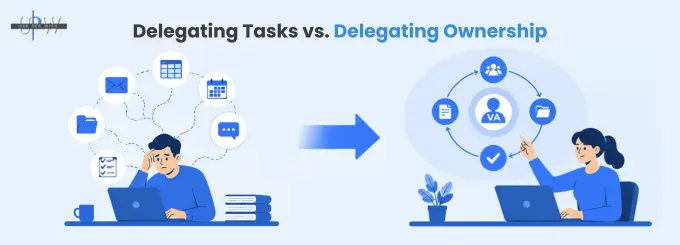
The Problem Founders Face: Delegating Tasks vs. Delegating Ownership
When you hire a virtual assistant or team member, a critical mistake happens.
You delegate tasks. You should delegate workflows.
The difference:
– Task delegation: “Reply to this email.” “Update the spreadsheet.” “Book this meeting.”
– Workflow ownership: “You own client onboarding.” “You manage lead follow-up.” “You run our inventory system.”
Why This Matters
When you delegate tasks:
– Every decision still passes through you
– Your team constantly seeks approval
– You become a full-time dispatcher
– You spend half your day answering “Can I do this?”
When you delegate ownership:
– Team members understand the objective
– They make decisions within defined boundaries
– They solve problems before you know they exist
– You review outcomes, not actions
The result: One strategy creates dependency. The other creates capability.
The Core Problem: Managers vs. Ownership
What Most Founders Actually Do
The traditional workflow looks like this:
1. Founder wakes up, checks emails
2. Founder creates a list of tasks
3. Founder sends 10+ messages to their VA
4. VA executes tasks perfectly
5. Next morning, process repeats
Problem: Nothing was actually delegated. The founder became a full-time task dispatcher.
The 2026 Approach: Workflow Ownership
Compare this to workflow-owning relationships:
Instead of: “Please onboard this client”
Say: “You own client onboarding”
This single sentence changes everything. The VA now:
– Ensures contracts are signed before meetings are booked
– Prepares onboarding documents
– Updates the CRM
– Introduces clients to the right team members
– Schedules milestone reviews
– Ensures first deliverables arrive on time
– Fixes problems independently
The founder’s job: Review one outcome, not manage 30 tiny actions.
That’s leverage.
Why Workflow Ownership Matters: 4 Key Benefits
1. It Gives You Your Brain Back
The biggest problem isn’t time. It’s attention.
Every micro-decision chips away at your mental bandwidth:
– Should we refund this customer?
– Which supplier should we use?
– Has this invoice been sent?
– Did someone follow up with that lead?
The effect: Individually minor. Collectively exhausting.
Your brain switches from strategic thinking to reaction mode:
– Reacting to emails
– Answering questions
– Approving decisions
– Repeating yourself
Workflow ownership changes this. Instead of 50 daily questions, your VA brings:
*”We onboarded twelve clients. One needed extra support, so I scheduled an additional session. Two haven’t completed their paperwork, and I’ve already followed up. Here’s what I’d like your opinion on.”
That’s leadership, not assistance.
2. It Breaks Bottlenecks
Businesses slow down for one reason: waiting.
– Waiting for approval
– Waiting for a decision
– Waiting for the founder’s input
The analogy: Imagine a busy restaurant where every waiter must ask the owner before pouring water. Customers would leave. Staff would get frustrated. The owner would be exhausted.
How most businesses operate: Every quote, refund, follow-up, and calendar change climbs the same mountain to reach the founder.
The result: The founder becomes an unintended bottleneck.
Ownership flips this. Your VA already knows the answer because:
– You’ve defined the outcome
– You’ve set clear boundaries
– They understand which decisions are theirs
– Only genuine edge cases come back to you
Everything else keeps moving. The business starts breathing on its own.
3. It Makes Remote Teams Feel Smaller, Not Bigger
Remote work doesn’t fail because of geography. It fails because nobody owns anything.
The Formula One pit crew example:
– Nobody asks permission to change tyres
– Nobody questions whose job it is to refuel
– Everyone already knows their role
– An entire car gets serviced in seconds
Why it works: Clear ownership, not constant supervision.
When everyone understands what they own:
– Distance becomes irrelevant
– One person finishes their day
– Another picks up where they left off
– The business keeps moving while you sleep
That’s not just efficient. It’s a massive competitive advantage for small businesses today.
4. It Creates Businesses That Actually Scale
Here’s the uncomfortable truth: Growth doesn’t create chaos. Growth exposes chaos.
– 10 customers forgive a messy system
– 100 customers might
– 1,000 definitely won’t
The bucket analogy: A bucket with tiny holes works fine when half full. Fill it to capacity and water leaks everywhere. The bucket didn’t change. You just exposed its weakness.
Workflow ownership plugs those holes before they become expensive:
– Instead of depending on memory, people follow systems
– Instead of relying on your availability, work follows clear processes
– Consistency becomes how the business operates, not something you hope for
Real-World Workflows: How It Works in Practice
E-Commerce: Inventory & Customer Experience
Task-based VA: Answers customer emails
Workflow-owning VA: Protects revenue and customer experience
They:
– Watch inventory before products run out
– Coordinate with suppliers
– Process returns
– Update product listings
– Check delivery issues before customers complain
– Spot patterns (increased returns on one product, regional shipping delays, unclear product descriptions)
The difference: Task assistants answer emails about problems. Owners fix why those emails exist.
Service Businesses: Managing the Client Journey
If you run an agency, consultancy, legal practice, coaching business, or accounting firm, this matters enormously.
What clients actually remember: How the relationship felt.
– Did responses happen quickly?
– Did onboarding feel smooth?
– Did deadlines arrive without surprises?
– Did they have to chase updates?
– Or were updates already waiting?
A workflow-owning VA manages this entire journey:
– CRM stays updated
– Meetings are scheduled
– Contracts are signed
– Progress reports go out
– Milestones are tracked
– Feedback gets collected
– Nothing slips through cracks
The founder focuses on delivering expertise. The VA protects the experience surrounding it.
Why clients stay: They often can’t explain exactly why they enjoy working with you. They just know everything feels organised. That’s not an accident. That’s ownership.
Operations: The Invisible Engine
Operations are like plumbing. Nobody notices when everything works. Everyone notices when it doesn’t.
What founders waste time on:
– Invoices
– Vendor management
– Expenses
– Internal reporting
– Task tracking
– Documentation
– Recurring admin
What a workflow-owning operations VA does: They don’t just complete admin. They improve it.
They might:
– Automate recurring reports
– Simplify approval processes
– Eliminate unnecessary workflow steps
– Fix bottlenecks nobody even named yet
The payoff: Six months later, everyone’s moving faster because of quiet structural improvements.
High-Impact Workflows to Delegate Today
These are the processes that should have clear ownership:
- Lead follow-up: From first enquiry to booked sales call
- Content production: Research, writing, publishing, performance tracking
- Bookkeeping basics: Expense tracking, invoice processing, monthly reconciliation
- Executive inbox and calendar: All inbox and schedule management
- CRM hygiene and pipeline: Keeping your sales system accurate and moving
- Recruitment coordination: Screening, interviewing, scheduling
- Vendor management and procurement: Supplier relationships and purchasing
- Customer success and retention: Proactive support and retention programmes
Notice what’s missing: “Send this email.” “Update this spreadsheet.” “Book this meeting.”
Those are tasks. A workflow is a living system.
The difference: Asking someone to wash one dish versus asking them to run the entire kitchen. One creates dependency. The other creates capability.
How to Make the Shift: Step-by-Step
Step 1: Pick One Workflow
Ask yourself one uncomfortable question:
“What’s the thing I secretly hope nobody asks me about tomorrow?”
That’s probably where you should start:
- Maybe it’s onboarding
- Maybe it’s chasing unpaid invoices
- Maybe it’s content
- Maybe it’s customer support
Whatever constantly pulls you out of deep work deserves a closer look.
Action: Don’t document everything. Document one workflow. Improve one workflow. Own one workflow. Then repeat.
Businesses don’t transform because of one massive change. They transform because of dozens of small improvements that compound over time.
Step 2: Hire for Curiosity, Not Just Competence
Software is teachable. Curiosity and ownership are not.
Instead of asking about tools, ask better questions:
- “Tell me about a process you made better.”
- “What’s a mistake you caught before anyone else noticed?”
- “Have you ever challenged the way something was being done?”
Those answers reveal how people think.
The best operators:
- Notice friction
- Ask questions
- Look for better ways
- Don’t wait for permission to improve
Those people become incredibly valuable over time.
Step 3: Create Guardrails, Not Chains
Ownership doesn’t mean losing control. It means replacing constant supervision with clear expectations.
Define:
- What success looks like
- Quality standards
- Turnaround times
- Which decisions your VA can make independently
- Which decisions should come back to you
Think of it like bowling. Guardrails don’t stop people from playing. They stop the ball from ending up in the gutter. The clearer the boundaries, the more confidently people can move.
Step 4: Use AI Like a Multiplier
The question isn’t, “Will AI replace virtual assistants?”
The better question is, “What happens when an experienced VA knows how to use AI well?”
With AI, your VA can:
- Complete research in minutes instead of hours
- Automatically organise meeting notes
- Create first drafts of routine emails
- Summarise reports automatically
- Eliminate repetitive admin
The result: Your VA spends less time clicking buttons and more time thinking.
The balance is simple. Technology handles repetition. People handle judgment.
Step 5: Build for Asynchronous Work
Not every conversation needs to be a meeting. Most don’t.
The most productive teams communicate through:
- Well-documented processes
- Recorded walkthroughs
- Project boards
- Concise written updates
Why? Documentation scales. Memory doesn’t.
If your business depends on you explaining the same process every month, you don’t have a process. You have a habit.
Turn habits into systems. Then let someone own them.
The Payoff: What Ownership Looks Like in Action
There’s a moment that happens in almost every growing business. It doesn’t happen overnight.
One day, you realise:
- Nobody has interrupted you for three hours.
- Your inbox isn’t overflowing.
- A client issue came up and got resolved without you.
- A supplier needed an answer, and your team handled it.
- You didn’t even know about it until the weekly update.
At first, it feels strange. Almost uncomfortable.
Here’s the uncomfortable truth: If your business can’t function without you making every decision, you don’t own a business. The business owns you.
The goal was never to become the busiest person in your company. It was to build something bigger than yourself.
That’s what workflow ownership creates:
- Your VA stops waiting for instructions.
- They protect a part of your business as if it’s their own.
- Trust replaces supervision.
- Systems replace stress.
- Growth stops feeling chaotic and starts feeling intentional.
The 2026 Competitive Advantage
The businesses winning in 2026 won’t necessarily have:
- The biggest budgets
- The largest teams
But they’ll almost certainly have this in common: Every critical workflow has an owner.
Your Challenge: Find Your First Workflow
Before you close this article, write down the three things that interrupted your work today.
Not the planned meetings. The interruptions. The questions. The decisions that pulled you away from what you were trying to accomplish.
Now ask yourself: Do these really require me?
If the answer is no, you’ve just found your next workflow to delegate.
Not as a task. As an outcome.
Because the real goal isn’t to build a business where everyone depends on you. It’s to build one where everyone knows what they own.
Ready to Delegate Ownership?
Stop managing tasks and start building systems. Create a virtual assistant partnership that gives you more than support. Create one that gives you your time, your focus, and your business back.
The VA upgrade your business needs in 2026 isn’t about hiring more people. It’s about empowering the people you have to own what actually matters.
That’s the shift.
That’s the advantage.
That’s the upgrade.
Virtual Administrative Assistants Services that You Can Outsource to Save Time and Money
Payroll Outsourcing Services: Costs, Benefits, and How to Choose in 2026

How Virtual Assistants Help You Beat the Zero-Click Trap
About Author
