

01May 26 How New Zealand SMEs Are Using Indian VAs to Lower Operational Costs by 60% in 2026
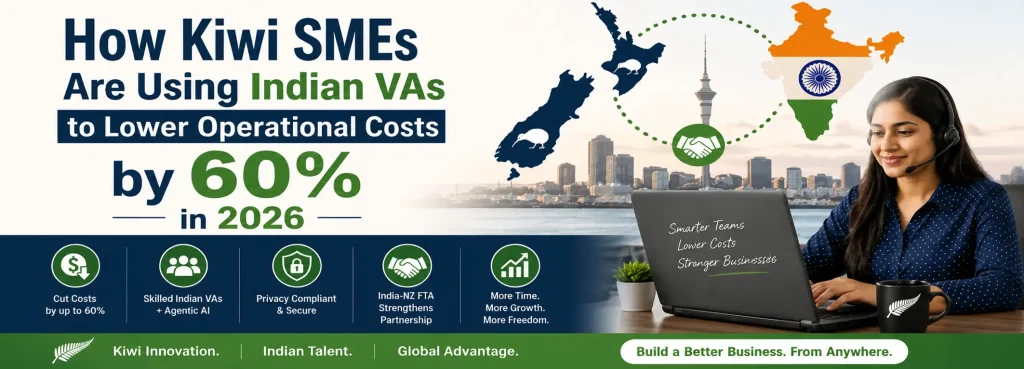
New Zealand SMEs are cutting operational costs by ~60% by hiring Indian Virtual Assistants (VAs) integrated with Agentic AI (autonomous workflows).
The savings come from direct labor arbitrage (NZ $44/hr vs. India $6–10/hr), plus eliminating compliance, recruitment, and office overhead.
The India-NZ Free Trade Agreement (FTA) and Privacy Act 2020 updates provide legal certainty and guardrails.
Key takeaway: This is not just cost-cutting – it is a structural shift to “intelligence arbitrage” that builds enterprise value and founder freedom.
The 2026 Catalyst – New Zealand’s Cost Crunch
The most important thing to remember: New Zealand SMEs are not imagining the pressure—they’re living it daily. Electricity bills inch up month after month, wages rise (as they should), and compliance quietly eats into already thin margins. What once felt manageable now feels like a constant squeeze.
In summary: 82% of SMEs saw overhead increases in the past year, averaging $1,490 more per month. Compliance costs for small firms rose $1,067 annually. 54% of owners plan price increases—but many know that passing costs to customers is not always sustainable.
Most common mistake: Hoping this is temporary. It isn’t. These are structural shifts. Waiting doesn’t ease the pressure—it compounds it.
The 60% Savings Breakdown – Three Vectors
To compare the savings drivers in simple terms:
Direct labor arbitrage means you pay about NZ $44/hour locally, but only $6–10/hour in India for similar admin work, saving around 70–80%.
Eliminated on-costs means you don’t have to pay KiwiSaver, ACC levies, holiday pay, or public holidays, saving roughly 75%.
Removed infrastructure means no office rent, setup costs, utilities, or recruitment fees, which cuts 100% of those expenses.
Key takeaway: The real cost of hiring locally is not just the salary—it includes many extra expenses. When you compare $55/hour for a local employee to $10–15/hour for an AI-supported VA, the 60–70% savings become clear.
Most common mistake: People only look at salary. They forget hidden costs like hiring time, training, and delays, where most savings actually come from.
The Agentic AI Revolution – From Task Doer to Workflow Orchestrator
The most important thing to remember: In 2026, a good VA doesn’t just “help”—they multiply your output. They sit at the center of systems, quietly keeping everything moving.
In summary: A VA now manages tools like Jira, ClickUp, and Salesforce—using built-in AI to triage emails, assign tasks, update records, and resolve routine issues. One person, supported by AI, can handle the workload of multiple roles.
Example workflow:
Step 1: A frustrated customer sends an email about a delay.
Step 2: AI flags urgency and sentiment.
Step 3: The VA steps in, resolves the issue, and replies within 30 minutes.
Step 4: The system logs everything and improves future responses.
Most common mistake: Thinking AI replaces people. It doesn’t. It removes the noise so the human can focus on judgment, empathy, and decisions.
Key takeaway: Growth is no longer tied to hiring more people. It’s about building smarter systems—and having the right person to run them.
Specialized Niche Clusters – Beyond General Admin
Xero-Certified Financial & Bookkeeping VAs
Action: Many Indian VAs are trained on Xero and handle reconciliations, payroll prep, and reporting with surprising precision. They follow NZ frameworks closely, often better than expected.
Common mistake: Assuming geography limits capability. In reality, training and systems matter more than location.
Real Estate & Property Management VAs
Action: From tenant communication to document workflows, VAs quietly handle the repetitive load that slows agencies down. They keep things moving when local teams are stretched.
Common mistake: Not defining decision boundaries. Without clarity, everything gets escalated—and efficiency is lost.
E-commerce & Logistics VAs
Action: Beyond order tracking, VAs optimize listings, analyze returns, and spot patterns that owners often miss. They don’t just support growth—they contribute to it.
Common mistake: Treating them as task executors instead of insight contributors.
The Privacy Act 2020 – New Compliance Rules for Using Indian VAs
The most important thing to remember: Trust is not optional—it’s designed into the system. And in 2026, compliance expectations are clearer than ever.
What this means for you:
· If your VA collects or sources personal data, transparency is required.
· The law applies even if the work is done offshore.
· Sensitive data (like biometrics) now comes with stricter timelines and controls.
Step-by-step compliance for SMEs:
Step 1: Appoint a Privacy Officer.
Step 2: Update contracts with clear obligations.
Step 3: Work with trained, privacy-ready VA partners.
Most common mistake: Assuming distance reduces responsibility. It doesn’t. If anything, it increases the need for clarity.
The India-NZ Free Trade Agreement (FTA) – A Game Changer
In summary: The FTA isn’t just policy—it’s a signal. It tells businesses that this collaboration is not temporary; it’s encouraged.
Key FTA provisions for SMEs:
· Easier movement of skilled professionals.
· Stronger legal backing for service outsourcing.
· Increased investment in cross-border collaboration.
· Lower costs for tools and infrastructure.
Most common mistake: Thinking this only benefits large companies. In reality, SMEs feel the impact faster because they’re more agile.
Key takeaway: The question is no longer “Should we explore India?” It’s “How soon can we make it work well?”
The “Owner Reliance” Risk – Why Delegation to VAs Builds Enterprise Value
The most important thing to remember: Many founders don’t realize how central they are—until they try to step away.
Only a small fraction of businesses can run without the owner. That gap limits growth, freedom, and even exit opportunities.
How Indian VAs help:
· They document processes and make knowledge transferable.
· They take over repeatable tasks that drain focus.
· They help turn the business into a system—not a dependency.
Most common mistake: Delegating tasks without transferring knowledge. True leverage comes from systems, not shortcuts.
Key takeaway: This isn’t just operational—it’s emotional. The ability to step back, even briefly, changes how a business feels to run.
Overcoming Cultural and “Hierarchy” Gaps – Strategic HR Moves
The most important thing to remember: Good collaboration doesn’t happen by default—it’s built intentionally.
How successful SMEs bridge the gap:
· Clear roles between human judgment and AI execution.
· Respectful conversations around data, trust, and expectations.
· Strong async communication habits—written clarity over constant calls.
· Defined tools and boundaries to prevent data risks.
Step-by-step to reduce friction:
Step 1: Write a simple team playbook.
Step 2: Create a safe space for honest updates.
Step 3: Define common terms and expectations clearly.
Most common mistake: Assuming alignment will happen naturally. It rarely does without guidance.
FAQ – Kiwi SMEs and Indian VAs
Q1: Is the 60% cost reduction realistic for a very small business (1–5 employees)?
A: Yes. Especially if you’re personally handling admin work. Even part-time delegation can unlock meaningful savings and time.
Q2: What about time zone differences – does that cause delays?
A: Often the opposite. Work continues while you sleep. The key is clear handoffs.
Q3: How do I ensure data security with an Indian VA?
A: Use limited access, strong authentication, and clear agreements. Think systems, not trust alone.
Q4: What is Agentic AI – and do I need to buy it separately?
A: It’s already inside many tools you use. The value comes from knowing how to use it well.
Q5: Can an Indian VA handle NZ-specific tax or legal work?
A: They can process and prepare—but final decisions should stay with licensed professionals.
Q6: How do I measure success after hiring an Indian VA?
A: Look at time saved, cost reduced, and consistency improved.
Q7: What is the “Value Gap” and how does a VA close it?
A: It’s the difference between a business that depends on you and one that runs without you.
Q8: Do I need to speak Hindi or understand Indian culture?
A: No. Clarity and consistency matter more than cultural fluency.
Final Checklist – Is Your Kiwi SME Ready for an Indian VA?
Ask yourself:
· Are you spending more than 10 hours/week on repetitive tasks?
· Has your overhead noticeably increased?
· Do you feel tied to daily operations?
· Are you aware of AI tools but not using them fully?
· Is your compliance updated for recent changes?
If you answered “yes” to 3 or more: You’re closer than you think.
Final key takeaway: This shift isn’t just about saving money—it’s about breathing room. It’s about building a business that doesn’t demand all of you, all the time.
Bottom line: Start small. One role. One VA. One clear outcome.
Give it three months.
What you’ll likely gain isn’t just savings—it’s clarity, momentum, and a little bit of your time back.
Real Estate Virtual Assistant Services – Where Human Skill Meets AI Power
Virtual Administrative Assistants Services that You Can Outsource to Save Time and Money

Top Tips For Reverse Video Search: A 2026 User’s Guide
About Author

