

10 Hidden Costs of Using AI Tools
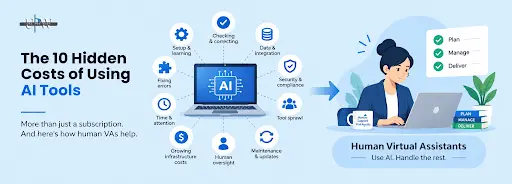
AI tools are remarkably easy to buy.
That is part of the problem.
A company can add an AI writing tool, an automation platform, a meeting assistant, an image generator or an AI agent in minutes. The price is usually plain enough: a monthly subscription, a usage charge, perhaps a few dollars for additional credits.
What is less apparent is what happens around the tool.
Someone has to prepare the information it needs. Someone has to write the prompts, check the output, fix what is wrong, move the work into another system and make sure sensitive information has not gone somewhere it should not. Someone has to keep the whole arrangement working when the software changes.
The subscription is the visible cost. Much of the real cost is elsewhere.
For busy companies, this is where a human virtual assistant can make an important difference. Rather than asking AI tools to carry an entire workflow on their own, a VA can use them as instruments, while taking responsibility for the parts that still require judgement, continuity and human attention.
Here are ten costs worth counting.
1. The Cost of Learning Yet Another Tool
Every AI application comes with a small tax on attention.
There is a new interface to learn, a new set of instructions to understand, new settings to configure and a new way of doing something that was already being done another way.
One tool may save ten minutes on a task while requiring hours of experimentation before anyone learns how to use it properly.
That cost is easy to dismiss because it rarely appears on an invoice.
A capable VA can take that burden off the owner’s desk. The assistant learns the tool, develops a workable process and uses it repeatedly, rather than asking the person running the business to become an amateur operator of half a dozen AI platforms.
2. The Cost of Checking What AI Produces
AI can produce an answer quickly. That does not mean the answer is ready.
A report may contain an incorrect figure. A research summary may miss an important qualification. A generated email may sound perfectly plausible while getting a small but consequential detail wrong.
The faster the machine produces work, the more tempting it becomes to accept the work without proper scrutiny.
That is where the supposed saving can become rather thin.
A human VA can sit between the tool and the final deliverable: checking facts, comparing information, correcting errors and making sure the finished work actually makes sense.
AI does the first pass. The person makes it usable.
3. The Cost of Fixing AI’s Mistakes
Checking an error is one cost. Repairing it is another.
An AI tool can create a spreadsheet with a faulty formula, produce an inaccurate transcription, classify something incorrectly or generate content that needs substantial rewriting.
The original task may have taken five minutes.
The correction can take twenty.
This is one of the more peculiar economics of AI: a tool can reduce the time required to produce something while increasing the time required to verify whether it deserves to be used.
A VA can handle the corrective work without pulling the business owner into every small imperfection.
4. The Cost of Prompting and Re-Prompting
There is a curious assumption surrounding AI: that once the right tool has been purchased, the work becomes automatic.
In practice, good results often depend on good instructions.
Prompts need refinement. Context needs to be supplied. Outputs need to be regenerated. Instructions have to be adapted for different situations.
For an occasional user, this is manageable. For a busy owner, it can become another form of administrative work.
A trained VA can develop reusable prompts, templates and workflows and learn what the business actually means by “good.” That accumulated familiarity matters. The assistant is not merely operating the tool. The assistant is learning the work around it.
5. The Cost of AI Tool Sprawl
One AI tool becomes three. Three become eight.
There is an application for writing, another for meetings, another for design, another for automation, another for research and another for customer communication.
The monthly charges may still look modest individually. Together, they become software clutter.
Worse, different people may purchase tools that perform substantially the same function.
A human VA can often reduce this sprawl by becoming the person who knows which tool is actually needed for which task. Instead of every employee becoming responsible for an expanding collection of applications, one capable operator can manage much of the practical workload.
6. The Cost of Connecting Everything
AI rarely exists in isolation.
The useful version of an AI workflow usually has to touch something else: email, spreadsheets, calendars, CRMs, accounting software, project-management systems, websites or internal databases.
Connecting those systems can be surprisingly laborious.
And when something stops working, somebody has to find out why.
A VA with the right technical competence can manage much of this operational layer, whether through native integrations or tools such as Zapier, Make or n8n. The important distinction is that the business does not have to spend the owner’s time keeping the machinery connected.
7. The Cost of Security and Oversight
Convenience can make people careless.
Employees may paste confidential material into an AI application without considering where the information is going. They may create accounts without approval or connect an AI service to a business system simply because the integration is available.
The software may be inexpensive. The consequences of careless use may not be.
A human assistant provides an additional layer of accountability. A properly trained VA can follow defined procedures for handling sensitive information, use approved tools and flag situations that should not be automated.
AI can follow instructions.
A person can recognise when an instruction itself is questionable.
8. The Cost of Maintaining AI Workflows
AI tools change.
Interfaces are redesigned. Features disappear. Pricing changes. Models are updated. Integrations break. A workflow that worked beautifully six months ago can quietly stop behaving as expected.
This creates a maintenance burden that is rarely included in the original calculation.
Someone has to notice the failure and repair the process.
For an owner, this is particularly wasteful. There is little business value in spending an hour discovering why an automated workflow stopped moving data between two applications.
A VA can own that maintenance work and keep the workflow serviceable while the owner concentrates on work that actually requires the owner’s presence.
9. The Cost of Trying to Make AI Replace Judgement
This may be the most expensive mistake.
Some work is repetitive enough to automate. Some is not.
A customer complaint, an unusual bookkeeping entry, a sensitive email, an important prospect, a complicated research question or a decision involving incomplete information may require judgement rather than generation.
When companies attempt to automate such work completely, they often end up creating elaborate systems designed to imitate judgement.
That can be far more complicated than simply having a capable person handle the exception.
The better model is often not AI instead of people.
It is AI with people.
Let the tool handle the mechanical portion. Let the VA handle the exceptions, decisions, follow-up and human communication.
10. The Cost of Your Own Attention
There is one cost that rarely appears in an AI budget.
Yours.
Every new tool requires some amount of attention from the person responsible for the business. You have to decide whether to use it, test it, understand it, supervise it and decide whether the result can be trusted.
Ten AI tools can therefore create ten small demands on the person who already has too many.
This is where a human VA can provide something an AI subscription cannot: ownership of the task.
You do not need another application telling you what could be done.
You need someone to make sure it gets done.
AI Is a Tool. Someone Still Has to Run the Work.
The mistake is not using too much AI.
The mistake is assuming that buying AI eliminates the human work surrounding it.
It does not.
AI can generate, summarise, classify, transcribe, analyse and automate. But businesses still need someone to decide what matters, check what is produced, correct what is wrong, maintain the workflow and carry the work through to completion.
That is why a human virtual assistant can be a better complement to AI than another AI tool.
The VA does not have to compete with the technology. The VA can make the technology useful.
Instead of asking an owner to become a prompt engineer, automation manager, fact-checker, software administrator and quality-control officer on top of everything else, a company can give those responsibilities to a capable assistant.
The arithmetic then changes.
You are no longer paying for an AI tool and hoping it saves time.
You are paying for the work to be done, with AI helping the person doing it work faster.
That is a much more useful way to think about the economics of AI.

Small Business Functions That Can Be Outsourced Easily
How Virtual Assistants Make Your AI Content Lively

5 Proven PPC Strategies to Improve ROI and Conversions
About Author

victor
Vicky Prasad (Victor) is a Virtual Assistant veteran and Digital Marketing team lead with more than 12 years of experience serving over 6,000 clients around the world. Leading dedicated teams, he specializes in executive support, business productivity systems, workload management, digital marketing leadership, and tailored growth strategies that help entrepreneurs and companies scale effectively.
